—
## **The Most Common Reason: Bruising During Processing**
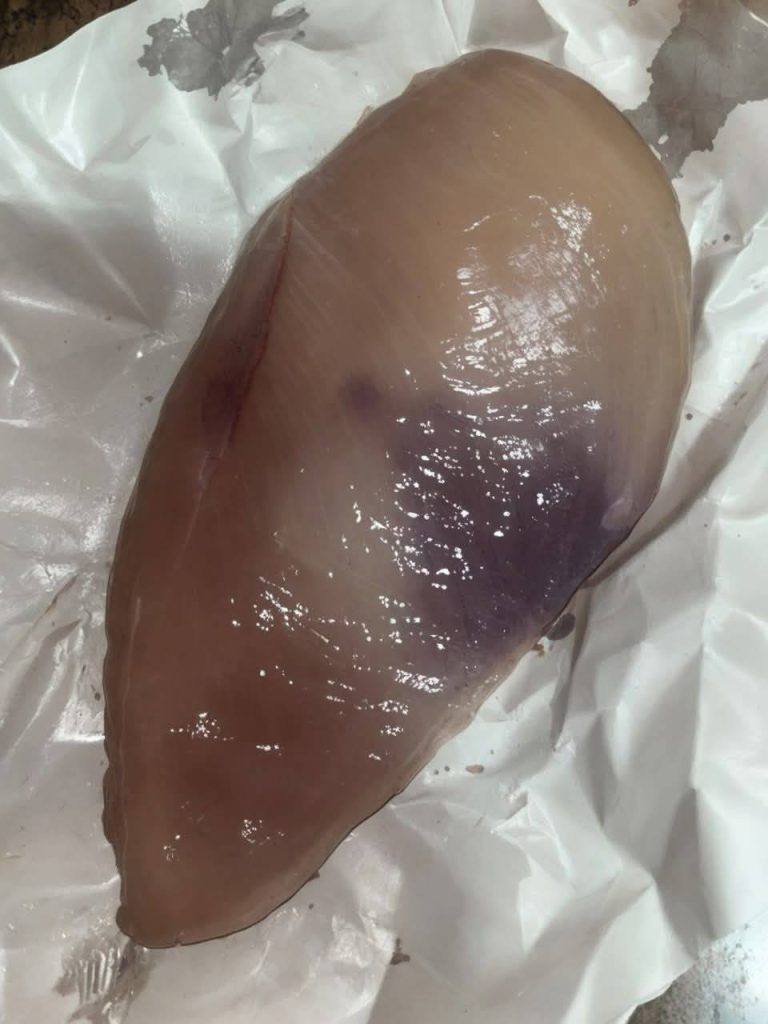
The most common cause of purple spots on chicken breast is **bruising**.
Chickens are living animals, and during processing (transport, handling, slaughter), small blood vessels can rupture. When this happens, **blood leaks into surrounding muscle tissue**, creating a bruise — just like in humans.
### **Why Bruises Look Purple**
Bruises appear purple because of:
* Trapped blood under the tissue
* Oxygen-deprived hemoglobin
* Muscle fibers absorbing blood pigments
This discoloration can remain visible even after the meat is chilled or frozen.
### **Is Bruised Chicken Safe to Eat?**
✔️ **Yes — if the chicken smells normal and isn’t slimy, bruising alone does not make it unsafe.**
* The texture may be slightly tougher
* The appearance may be unpleasant
* Some people choose to trim the spot away
From a food safety standpoint, bruising is not the same as spoilage.
—
## **Another Common Cause: Blood Spots or Hematomas**
Sometimes what looks like a purple spot is actually a **hematoma**, which is a localized collection of blood.
### **Why Hematomas Happen**
* Incomplete bleeding during processing
* Minor damage to blood vessels
* Rapid chilling that traps blood in muscle fibers
* Larger chicken breasts
* Meat closer to bones
* Factory-processed poultry
### **Are Blood Spots Dangerous?**
✔️ **No — blood spots are not harmful on their own.**
They are considered a **quality issue**, not a safety issue.
Many people simply:
* Trim the area
* Cook the chicken thoroughly
* Discard if appearance is too unappealing
—
## **Purple vs. Gray or Green: Important Differences**
Not all discolorations are equal. Color matters.
### **Purple or Dark Red**
* Usually bruising or trapped blood
* Typically safe if odor and texture are normal
### **Gray or Green**
* Can indicate spoilage
* Often associated with bacterial growth
* Frequently accompanied by bad smell
### **Yellow or Slimy Areas**
* Strong warning sign
* Likely unsafe
If your chicken has a **purple spot but still smells fresh and feels firm**, that’s a very different situation than meat that smells sour or feels sticky.
—
## **What About Spoilage? Could Purple Mean the Chicken Is Bad?**
Spoilage typically comes with **multiple signs**, not just color.
### **Signs of Spoiled Chicken**
* Sour, rotten, or sulfur-like smell
* Slimy or sticky texture
* Greenish, gray, or milky film
* Excessive gas in packaging
* Unusual softness
A purple spot **by itself** is rarely a sign of spoilage.
When in doubt, **trust your nose before your eyes**.
—
## **Could It Be a Disease in the Chicken?**
This is a common fear — and an understandable one.
The answer: **Very unlikely**.
Chickens raised for food are inspected, and diseased animals are not approved for sale. Purple spots are almost always **mechanical or handling-related**, not signs of illness.
Foodborne illnesses like salmonella **do not show up as purple spots**. They are invisible and related to bacteria, not muscle discoloration.
—
## **Freezer Burns vs. Purple Spots**
Sometimes people confuse freezer damage with bruising.
### **Freezer Burn Looks Like**
* Grayish-white patches
* Dry or leathery texture
* Not purple or red
Freezer burn affects texture and flavor but is **not dangerous**. Purple spots, on the other hand, usually form **before freezing**, during processing.
—
## **Can Cooking Change the Color?**
Yes — cooking often reduces or eliminates the appearance of purple spots.
During cooking:
* Blood pigments break down
* Meat color evens out
* The spot may turn brown or disappear
This is another reason why many people choose to simply trim the area or cook the chicken normally.
—
## **When You Should NOT Eat the Chicken**
Even if the spot is purple, discard the chicken if:
* It smells bad (sour, rotten, egg-like)
* The texture is slimy
* The color is green or gray
* The packaging was bloated
* It’s past the use-by date and shows changes
When safety is uncertain, throwing it out is always the safer option.
—
## **What Food Safety Experts Recommend**
According to food safety guidelines:
* Color alone is not a reliable indicator of safety
* Smell and texture are more important
* Proper cooking eliminates bacteria
Chicken should always be cooked to an **internal temperature of 165°F (74°C)**.
—
## **Why This Happens More Often Than You Think**
With mass poultry production, small imperfections are common.
Most people simply don’t notice them until:
* Cooking at home more often
* Buying larger chicken breasts
* Using clear packaging
* Sharing photos online
Social media has made these questions far more visible — but the issue itself isn’t new.
—
## **How to Handle Chicken with a Purple Spot**
If you decide to use it:
1. Inspect the meat closely
2. Smell it carefully
3. Trim the discolored area if desired
4. Wash hands and surfaces thoroughly
5. Cook to proper temperature
Never rinse raw chicken — this spreads bacteria.
—
## **Why It’s Okay to Be Cautious**
Food safety concerns are valid. It’s normal to be cautious when something looks unusual.
Remember:
* You’re not wrong for questioning it
* You’re not overreacting
* Asking is better than guessing
If something makes you uncomfortable, you don’t need to justify throwing it away.
—
## **Final Thoughts**
A purple spot on chicken breast looks unsettling — but in most cases, it’s simply **bruising or trapped blood from processing**, not spoilage or disease.
As long as the chicken:
* Smells fresh
* Feels firm
* Shows no slime or greenish color
…it is generally safe to cook and eat.
That said, **your comfort matters**. If something feels off, it’s okay to discard it and choose peace of mind.
Food safety isn’t just about rules — it’s about trust, awareness, and confidence in what you’re feeding yourself and your family.
When in doubt: smell, inspect, cook thoroughly — or throw it out.
