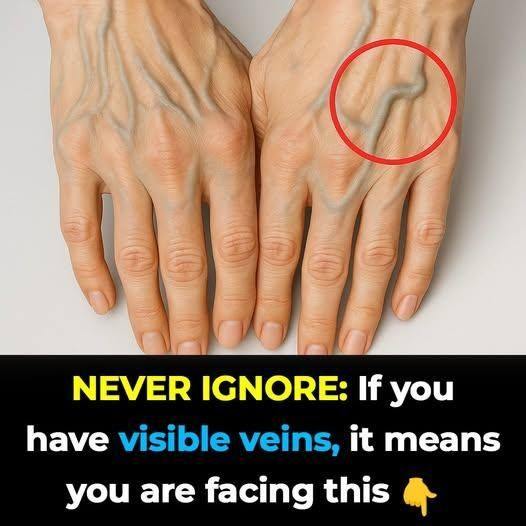
If you have:
* Thin skin
* Less subcutaneous fat
* Naturally prominent veins
This is especially common in individuals with lighter skin tones, where veins contrast more strongly against the skin. If visible veins run in your family, chances are this is a normal anatomical trait rather than a health concern.
—
## **2. Aging and Skin Changes**
As we age, our skin undergoes significant changes:
* Collagen production decreases
* Skin becomes thinner
* Elasticity reduces
* Fat beneath the skin diminishes
These changes make underlying structures—like veins—more noticeable. That’s why visible veins on the forehead often become more apparent with age, even in people who never noticed them earlier in life.
This process is natural and usually harmless.
—
Have you ever noticed your forehead veins popping out during or after a workout?
That’s because **exercise increases blood flow and blood pressure**. As your heart pumps harder to deliver oxygen to your muscles, veins can temporarily enlarge and become more visible.
Additionally, increased body temperature causes blood vessels to dilate (a process called vasodilation), pushing veins closer to the skin’s surface.
Once your body cools down and your heart rate returns to normal, the veins typically become less noticeable.
—
## **4. Stress, Anger, and Strong Emotions**
Emotional stress doesn’t just affect your mood—it affects your body.
* Your heart rate increases
* Blood pressure rises
* Blood vessels dilate
This combination can cause veins—especially in the face and forehead—to stand out more than usual. This is why forehead veins are sometimes associated with anger or intense concentration.
In these cases, visibility is temporary and fades once your nervous system calms down.
—
## **5. Heat and Environmental Factors**
Hot weather can make forehead veins more visible.
When your body heats up, it dilates blood vessels near the skin to release excess heat. This is a natural cooling mechanism. Because the forehead has minimal fat and thin skin, veins in this area often become more prominent in warm environments.
Once you cool down, the veins typically recede.
—
## **6. Dehydration**
Dehydration reduces plasma volume in your blood, which can make veins appear more prominent.
When you’re dehydrated:
* Blood becomes thicker
* Blood vessels may dilate to maintain circulation
* Skin loses plumpness
Together, these effects can make veins stand out more clearly, including those on the forehead.
Staying properly hydrated can help minimize this effect.
—
## **7. Weight Loss and Reduced Body Fat**
Significant or rapid weight loss—especially facial fat loss—can make veins more visible.
Fat acts as a cushion beneath the skin. When that cushion thins, veins become more noticeable. This is common in people who:
* Lose weight quickly
* Have very low body fat
* Age while maintaining a lean physique
Again, this is usually a cosmetic change rather than a medical concern.
—
## **8. Hormonal Changes**
Hormones influence blood flow, skin thickness, and vessel dilation.
Hormonal shifts can occur due to:
* Pregnancy
* Menopause
* Menstrual cycle changes
* Hormonal medications
These changes may temporarily increase vein visibility, particularly in areas with thin skin like the forehead.
—
## **9. High Blood Pressure (In Some Cases)**
While visible veins alone do **not** diagnose high blood pressure, consistently prominent veins—especially when accompanied by other symptoms—may warrant attention.
High blood pressure can increase pressure in blood vessels, sometimes making veins more noticeable. However, many people with hypertension have no visible signs at all.
If visible forehead veins appear suddenly and persist alongside headaches, dizziness, or vision changes, medical evaluation is recommended.
—
## **10. Sinus Congestion or Straining**
Activities that increase pressure in the head can temporarily enlarge forehead veins.
These include:
* Heavy lifting
* Straining during bowel movements
* Intense coughing
* Severe sinus congestion
These actions increase pressure in the venous system, making veins more visible for short periods.
—
## **When Visible Forehead Veins Are Usually Harmless**
In most cases, visible forehead veins are **not a sign of disease**. They are often caused by:
* Genetics
* Aging
* Exercise
* Heat
* Stress
If they appear occasionally and fade with rest, cooling, or relaxation, there’s usually no reason for concern.
—
## **When You Should Pay Closer Attention**
While rare, visible forehead veins may need medical evaluation if they are:
* Sudden and persistent
* Painful or tender
* Accompanied by severe headaches
* Associated with vision problems
* Linked to swelling or skin discoloration
These symptoms could indicate vascular inflammation, infection, or other conditions that require professional assessment.
—
## **Can You Reduce the Appearance of Forehead Veins?**
If the visibility bothers you cosmetically, there are options—though most address appearance rather than health.
### **Lifestyle Adjustments**
* Stay hydrated
* Manage stress
* Avoid excessive heat
* Maintain balanced nutrition
### **Cosmetic Options**
* Makeup or color correction
* Laser treatments
* Dermal fillers (performed by professionals)
Always consult a qualified medical or dermatological professional before pursuing cosmetic treatments.
—
## **The Bigger Picture: What Your Body Is Doing**
Visible veins are often a sign that your body is responding appropriately to its environment—cooling down, circulating blood efficiently, or reacting to physical and emotional demands.
Rather than a flaw, they’re a reminder that your circulatory system is active and responsive.
—
## **Final Thoughts**
Seeing veins on your forehead can be surprising, but in most cases, it’s completely normal. Factors like genetics, aging, exercise, stress, and temperature all play a role in how visible your veins appear.
The key is context.
If visible veins come and go and aren’t accompanied by concerning symptoms, they’re likely harmless. But if something feels off—or if changes are sudden and persistent—it’s always wise to seek medical advice.
Your body often speaks in subtle ways. Learning to understand those signals can help you respond with clarity rather than concern.
—
If you’d like, I can:
* Turn this into a **short viral health post**
* Adapt it for **dermatology or wellness blogs**
* Add a **FAQ or myth-busting section**
* Simplify it for **general audiences**
Just let me know 👀
