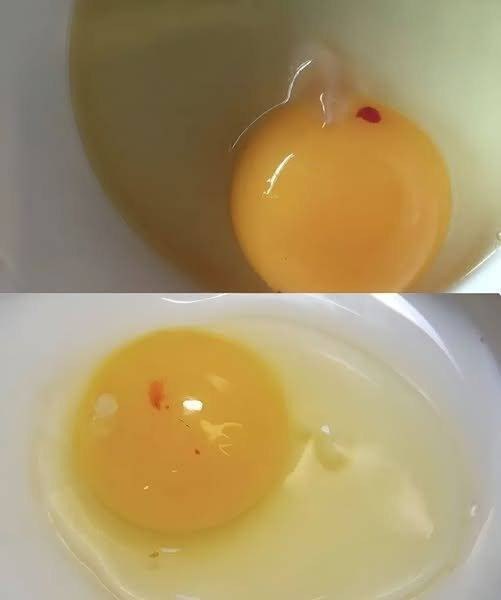
To understand red spots, a quick look at how an egg forms helps:
1. **Egg formation:** Eggs develop inside a hen. The yolk is released from the ovary and travels through the oviduct, where egg white (albumen) and the shell are added.
2. **Blood vessel rupture:** Occasionally, a tiny blood vessel on the yolk’s surface ruptures as it forms — resulting in a blood spot.
3. **Natural variation:** Like freckles on people, some eggs just naturally have these spots.
* **Young or older hens:** Younger hens may have immature reproductive systems, which can lead to more blood spots.
* **Genetics:** Some chickens are more prone to blood spots than others.
* **Environmental stress:** Heat, stress, or abrupt changes in diet may contribute to more frequent blood spots.
—
## 🍽️ Are Red Spots Safe to Eat?
**Yes.** In most cases, red spots in eggs are *completely safe to eat.* They don’t mean the egg is rotten or contaminated.
Here’s what food safety experts say:
* Blood spots are harmless and don’t affect nutritional value or quality.
* The egg is still good — as long as it smells fine and the shell isn’t cracked or slimy.
* You can simply remove the red spot with the tip of a knife or spoon if it bothers you, but it’s not required.
The *real safety concerns* with eggs are things like salmonella contamination — which has nothing to do with red spots and is related to bacteria sometimes found on or inside eggs. Proper cooking and handling help mitigate those risks (more on that later).
—
Red spots alone aren’t a sign of spoilage, but you should always check the egg for other warning signs:
### 🚩 Signs the Egg *May* Be Bad
* Foul or sulfur-like odor
* Slimy or powdery shell (possible mold)
* Unusual or cloudy egg white (when broken into a bowl)
* Floating when placed in water (more about that below)
If an egg shows these signs, it’s best not to use it — no matter whether it has red spots.
—
## 🔍 How to Tell if an Egg Is Fresh
Here are a few simple freshness tests before cracking:
Fill a bowl with cold water and gently place your egg in it:
* **Sinks and lays flat:** Very fresh
* **Sinks but stands upright:** Still okay, less fresh
* **Floats:** Old — discard
Why this works: Eggs have an air cell that enlarges over time as moisture and carbon dioxide escape. Bigger air cells cause older eggs to float.
—
## 🍳 Cooking Tips to Minimize Concern
If you’re uneasy about red spots but still want to cook with the egg, here are a few tricks:
### ✔️ Remove the Spot
* Crack the egg into a separate bowl before adding to the pan.
* Use a spoon or knife tip to gently pick out the red spot. This works especially well in recipes where appearance matters (like sunny-side-up eggs).
### ✔️ Mix Thoroughly
In recipes where eggs are beaten (e.g., omelets, baking), the spots often blend in and become virtually invisible.
### ✔️ Cook Thoroughly
If you’re worried about food safety in general:
* Ensure eggs reach **an internal temperature of 160°F (71°C)** in cooked dishes.
* Cook until yolks and whites are firm in fried or scrambled eggs.
This helps protect against bacterial contamination — unrelated to the red spots but important for safety.
—
## 🐓 Why You Might See More Red Spots in Some Eggs
Different farming practices and hen breeds can influence how often red spots appear:
### 🌾 Free-Range or Organic Eggs
Free-range or organic typically refers to how hens are raised, not egg quality indicators like blood spots. Some farms may even have more visible spots simply due to how they feed and manage flocks.
### 🍽️ Large Commercial Egg Producers
Many large producers screen eggs with optical detectors that reject those with visible blood spots — meaning supermarket eggs might have fewer visible spots compared to farm-fresh ones.
### 🐣 Younger Flocks
Flocks that have recently started laying tend to deliver more eggs with spots. As hens mature, the frequency usually decreases.
—
## 🧪 Debunking Common Misconceptions
Let’s address some myths that often circulate around red spots:
### ❌ “Red Spots Mean the Egg Is Fertilized”
Not necessarily. Fertilized eggs are a different concept — they may show a bull’s-eye pattern (embryo development) if incubated — but red spots can appear in both fertilized and unfertilized eggs.
### ❌ “The Egg Is Spoiled or Unsafe”
Not true. As long as there are no other signs of spoilage and the egg smells normal, it’s safe to cook and eat.
### ❌ “Blood Spots Make the Egg Harmful”
False. They’re simply natural anomalies from the chicken’s anatomy and don’t indicate bacteria or toxins.
—
## 🫖 Fun Facts About Eggs and Their Oddities
Eggs can surprise us in other ways too:
* **Double yolks:** Usually from young hens whose systems release two yolks at once.
* **Shell color:** Depends on breed — brown shells don’t mean more nutrients.
* **Bloom or cuticle:** A natural coating on eggshells that helps protect against bacteria.
Eggs are more complex than many people think!
—
## 🥘 Recipes Where Red Spots Don’t Matter
Here are a few dishes where red spots are barely noticeable:
* **Scrambled eggs or omelets:** Mixed in — no visibility.
* **Baked goods:** Cakes, cookies, breads — eggs are blended and baked.
* **Frittatas, quiches:** Mixed with other ingredients, spots vanish.
* **Egg fried rice or casseroles:** Texture and flavor mask imperfections.
In these cases, the flavor and nutrition are unaffected.
—
## 🍽️ When Presentation Matters
If you’re serving eggs where appearance counts (e.g., poached or sunny-side-up), and you see red spots, here’s how to handle them:
1. **Crack egg into a bowl first.**
2. **Remove any visible spot with a spoon.**
3. **Pour egg into the pan.**
This helps ensure a picture-perfect breakfast without wasting good eggs.
—
## 🧠 Final Verdict: Should You Worry?
**Not really.** Those red or brown spots are typically harmless blood or tissue remnants that occur naturally — and most of the time, they’re safe to eat as long as the rest of the egg looks and smells normal.
* They are *not* a sign of spoilage.
* They *don’t* make eggs unsafe.
* They *do* sometimes bother people cosmetically, but can be removed easily.
Eggs remain one of the most versatile, nutritious, and affordable foods — and a little blood spot shouldn’t stop you from enjoying them!
—
## 🍳 Quick Summary
| Question | Answer |
| ————————————– | ———————————————– |
| **Are red spots dangerous?** | No, usually safe to eat. |
| **Do they mean the egg is spoiled?** | No, unless other signs of spoilage are present. |
| **Can I remove them?** | Yes, easily. |
| **Do they affect taste or nutrition?** | No. |
| **Should I discard the egg?** | Only if it smells bad or has other issues. |
—
## 💬 Parting Thoughts
Next time you see one of those red spots, don’t panic. Think of it as a natural quirk of farm life — like a personality trait in an egg. With the right understanding, a bit of kitchen know-how, and a willingness to experiment, those tiny spots won’t ruin your meal — and might even make your breakfast routine a little more interesting.
Have you ever found a red spot in your egg? Share your experience or tips below! 🍳👇
