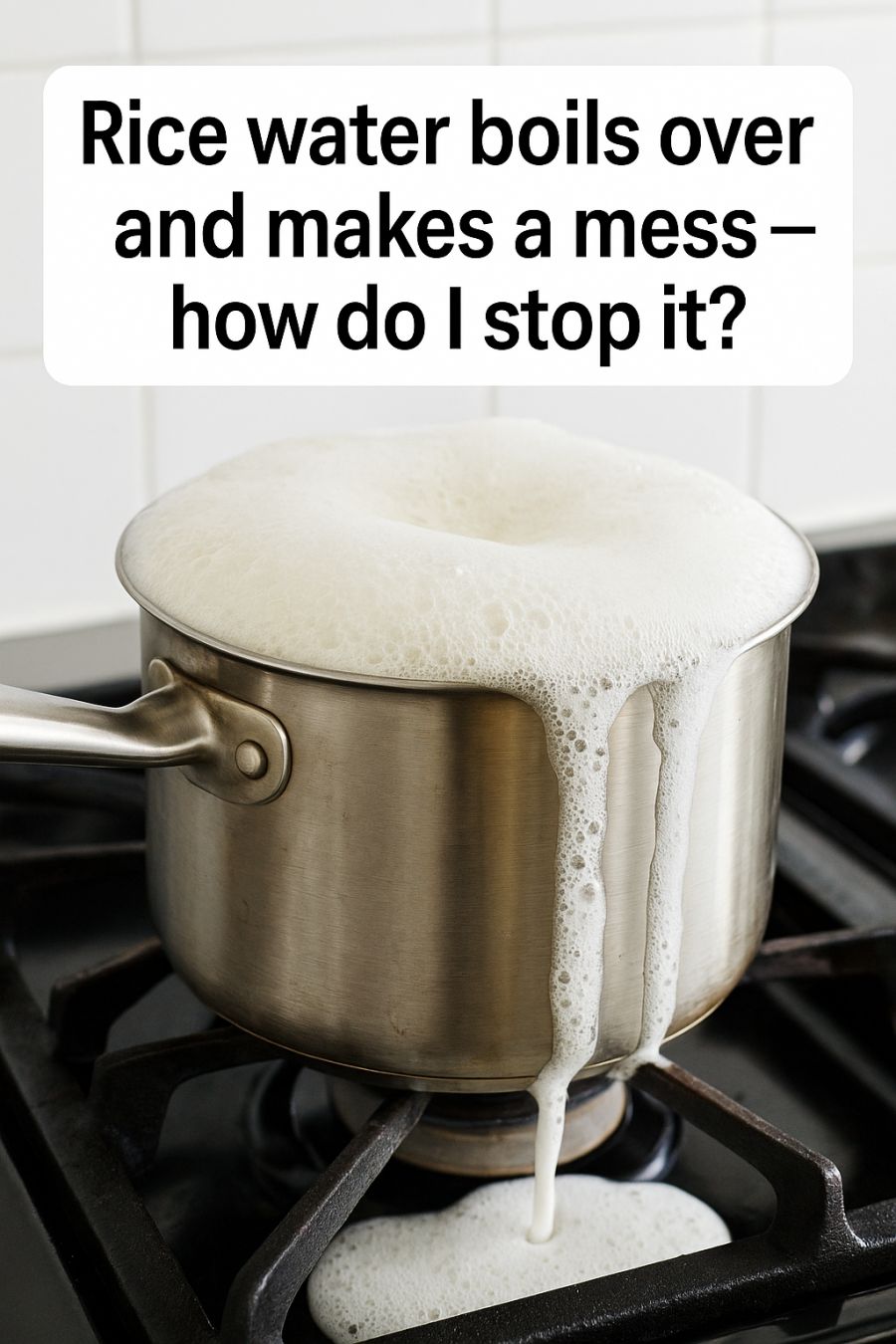
That starchy water forms **stable bubbles**—unlike plain water bubbles that pop quickly. These bubbles stack on top of each other, creating foam that climbs the sides of the pot.
### **The Boiling Point Problem**
Eventually, gravity loses — and the rice water spills over.
—
## **Common Mistakes That Make It Worse**
Before jumping into solutions, let’s look at what often *causes* the mess:
* Using a pot that’s too small
* Cooking rice on high heat the entire time
* Not rinsing the rice
* Using too much water
* Covering the pot too tightly
Any one of these can turn a calm simmer into a stovetop disaster.
—
## **Solution #1: Rinse Your Rice Thoroughly**
### **Why It Works**
Rinsing rice removes excess surface starch. Less starch in the water means:
* Fewer stable bubbles
* Less foam formation
* Lower chance of overflow
### **How to Do It Properly**
1. Place rice in a bowl or sieve
2. Add cold water
3. Swirl with your hand
4. Drain
5. Repeat 2–4 times until the water runs mostly clear
This simple step alone can dramatically reduce mess.
—
Rice expands as it cooks — and so does the foam.
### **The Ideal Pot Rule**
Choose a pot that holds **at least 2–3 times the volume** of the water and rice combined.
A larger pot:
* Gives foam space to rise without spilling
* Allows steam to escape more gradually
* Creates more stable heat distribution
When in doubt, go bigger.
—
## **Solution #3: Lower the Heat After Boiling**
One of the most common rice mistakes is keeping the heat too high.
### **The Correct Heat Method**
1. Bring water and rice to a boil
2. **Immediately reduce to low or medium-low**
3. Cover and simmer gently
Rice does *not* need aggressive boiling. Once it’s simmering, the grains cook just as effectively — without the eruption.
—
## **Solution #4: Leave the Lid Slightly Ajar**
A tightly sealed lid traps steam, increasing internal pressure.
### **The Fix**
* Slide the lid slightly off-center
* Or prop it open with a wooden spoon
This allows excess steam to escape and prevents foam from being forced upward.
—
## **Solution #5: Add a Drop of Oil or Butter**
This old-school trick actually works — and it’s backed by science.
### **Why It Helps**
Fat disrupts surface tension, causing bubbles to collapse faster.
Just:
* Add **½–1 teaspoon** of oil or butter to the water
This reduces foaming without affecting taste (especially for savory dishes).
—
## **Solution #6: The Wooden Spoon Trick (Does It Really Work?)**
You’ve probably seen this tip: lay a wooden spoon across the top of the pot.
### **Does It Work?**
Yes — temporarily.
The spoon:
* Breaks bubbles as they rise
* Prevents foam from climbing over the rim
### **The Catch**
It works best for:
* Short cooking times
* Moderate heat
It’s a helpful backup, but not a foolproof solution on its own.
—
## **Solution #7: Adjust the Water Ratio**
Too much water = more starch = more foam.
### **General Rice-to-Water Ratios**
* White rice: 1 cup rice : 1½–2 cups water
* Jasmine rice: 1 : 1½
* Basmati rice: 1 : 1½
* Brown rice: 1 : 2–2½
Using the right ratio reduces excess liquid that can foam and spill.
—
## **Solution #8: Try the Pasta Method (Drain After Cooking)**
For some types of rice, you can cook it like pasta.
### **How It Works**
1. Boil rice in plenty of water
2. Cook until tender
3. Drain in a sieve
This method:
* Eliminates boil-over anxiety
* Produces fluffy rice
* Works especially well for basmati and jasmine
The key is using a **large pot** and keeping an eye on it during the first boil.
—
## **Solution #9: Use a Rice Cooker or Instant Pot**
Modern appliances are designed to solve this exact problem.
### **Why They Work**
* Automatic heat regulation
* Built-in pressure control
* No open boiling
If you cook rice often, these tools can save time — and stovetop cleanup.
—
## **What NOT to Do**
Avoid these common mistakes:
* ❌ Cranking heat to “speed things up”
* ❌ Using a tiny saucepan
* ❌ Ignoring the pot during the boil phase
* ❌ Stirring constantly (this releases more starch)
—
## **Cleaning Up a Boil-Over (If It Happens Anyway)**
If rice water spills:
1. Turn off the heat
2. Let the stove cool
3. Wipe with warm water before starch hardens
4. For stubborn residue, use vinegar or baking soda
Cleaning quickly makes a huge difference.
—
## **A Simple Foolproof Method (Quick Recap)**
For mess-free rice every time:
1. Rinse the rice
2. Use a large pot
3. Bring to boil
4. Reduce heat immediately
5. Cover slightly ajar
6. Simmer gently
That’s it.
—
## **Final Thoughts: Rice Shouldn’t Be Stressful**
Rice is one of the world’s most comforting foods — simple, nourishing, and deeply familiar. It shouldn’t come with burnt stovetops and sticky cleanup.
Once you understand the science behind why rice boils over, preventing it becomes easy. A few small changes in technique can turn rice cooking from a mess into a routine you don’t even think about anymore.
So the next time you hear that ominous bubbling sound, you’ll know exactly what to do.
And your stove?
It’ll stay spotless.
—
If you want, I can:
* Turn this into a **short viral kitchen hack post**
* Adapt it for **SEO optimization**
* Rewrite it for a **casual or humorous tone**
* Create a **step-by-step infographic outline**
Just say the word! 🍚
