* Deli ham
* Roast beef
* Turkey slices
* Bacon
* Corned beef
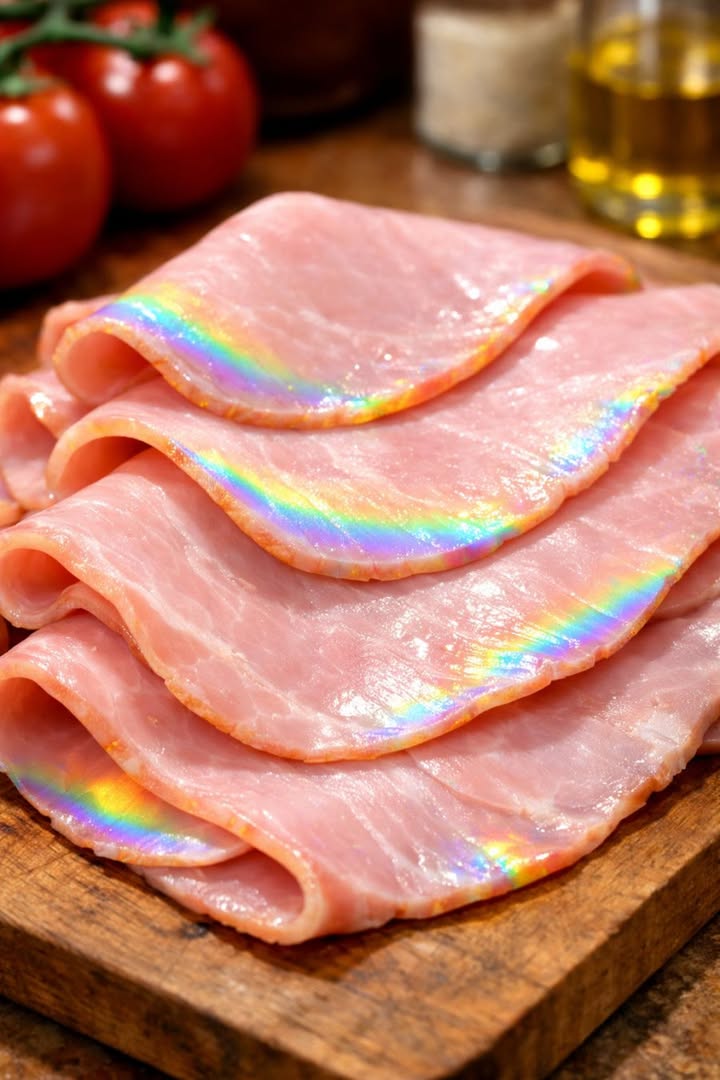
It can look strange—even unsettling—but it doesn’t automatically mean the meat has gone bad.
## What Causes the Rainbow Shine on Ham?
The shimmering colors aren’t bacteria, mold, or chemicals. They’re the result of **how light reflects off the muscle fibers in the meat**.
Here’s what’s happening behind the scenes:
### 1. Muscle Fibers Act Like Tiny Prisms
Meat is made up of long, organized muscle fibers. When ham is sliced very thin—especially by deli slicers—those fibers are cut at precise angles.
When light hits the surface:
* It bends and scatters across the muscle structure
* Different wavelengths reflect back to your eyes
* You see an oil-slick or rainbow-like effect
This is similar to how a CD, soap bubble, or peacock feather reflects light.
Ham is typically cured using salt and sometimes nitrates or nitrites. These curing agents stabilize proteins in the meat and can make the muscle structure more uniform—**which increases iridescence**.
So ironically, well-processed, evenly sliced ham is *more* likely to show this effect than poorly handled meat.
### 3. Cold Storage Makes It More Noticeable
When ham comes straight from the fridge, moisture on the surface and firm proteins reflect light more sharply. As the meat warms slightly, the shimmer may fade.
—
## Why It Looks So Unnatural (and Alarming)
Our brains are wired to associate rainbow colors on food with danger—mold, chemicals, or contamination. But iridescence doesn’t behave like spoilage.
* Appears only at certain angles
* Disappears or shifts when you move the slice
* Looks smooth and glossy, not fuzzy or patchy
Spoiled food usually looks *consistently wrong*. Iridescent meat looks *optically strange*, not biologically active.
—
## When a Rainbow Shine Is Totally Fine
You’re likely safe if **all** of the following are true:
* The ham smells normal (mild, salty, meaty)
* The texture is firm and not slimy
* There’s no fuzzy or powdery growth
* The color underneath the sheen is pink or light red (not gray or green)
* The package is within its use-by date
* It’s been stored properly in the fridge
If the only odd thing is the shimmering color when light hits it—**that’s iridescence, not spoilage**.
—
## When You Should *Not* Ignore It
While rainbow shine alone isn’t dangerous, it shouldn’t override other warning signs. Throw the ham away if you notice:
* **A sour, rotten, or sulfur-like smell**
* **Sticky or slimy residue that doesn’t rinse off**
* **Gray, green, or brown discoloration**
* **Visible mold** (white, blue, green, or black fuzz)
* **A swollen or leaking package**
* **An expired date**, especially if opened several days ago
Trust your nose more than your eyes. Spoilage announces itself loudly through smell and texture.
—
## Is It Safe to Eat?
If the ham:
* Smells fine
* Feels normal
* Has only a visual rainbow sheen
Then yes—**it’s generally safe to eat**.
Food scientists and meat processors widely recognize iridescence as a harmless optical effect. It doesn’t indicate bacterial growth, chemical contamination, or spoilage.
That said, food safety always includes personal comfort. If something makes you uneasy, you’re not wrong to skip it. Peace of mind matters too.
—
## Why You See This More with Deli Meat Than Whole Cuts
Ever notice how a whole ham or roast doesn’t usually look rainbowy, but deli slices do?
That’s because:
* Deli meat is sliced *extremely thin*
* The cut surface is very smooth
* Fibers are aligned in one direction
* Commercial slicers create uniform surfaces
All of this makes the meat a perfect canvas for light diffraction.
At home, thicker or rougher cuts scatter light more randomly—so you don’t get the same shimmering effect.
—
## Does Cooking Get Rid of the Shine?
Sometimes, yes.
Heating can:
* Change how light reflects off the proteins
* Reduce surface moisture
* Disrupt the smooth fiber structure
If the ham is safe but the appearance bothers you, warming it gently (for example, in a sandwich or omelet) often makes the iridescence less noticeable.
—
## What About Kids, Pregnant People, or High-Risk Groups?
If the ham is within date, stored properly, and shows no spoilage signs beyond iridescence, it’s considered safe for the general population.
However:
* Pregnant people are often advised to **heat deli meats** to steaming hot to reduce the risk of listeria
* The rainbow shine itself is not related to listeria or other pathogens
In other words, the visual effect isn’t the risk—the general deli meat guidelines still apply.
—
## How to Store Deli Ham to Reduce Weird Visual Changes
While you can’t fully prevent iridescence, proper storage helps keep deli meat looking and tasting its best:
* Keep it tightly sealed or in an airtight container
* Store it at or below 40°F (4°C)
* Avoid excess moisture buildup
* Use within 3–5 days of opening (unless otherwise stated)
Less air exposure means less surface drying and fewer visual surprises.
—
## Why This Question Comes Up So Often
Search engines are full of people asking about rainbow meat—and for good reason. Food today is more processed, more precisely sliced, and more visually inspected than ever before.
We expect food to look *perfect*, and when it doesn’t, alarm bells go off.
But sometimes, food science just looks weird.
—
## The Bottom Line
Seeing a rainbow-like shine on deli ham can be startling, but it’s usually just **iridescence**—a harmless interaction between light and meat fibers.
Remember:
* Rainbow sheen alone ≠ spoilage
* Smell, texture, and time matter more
* When in doubt, trust your senses
* When uncomfortable, it’s okay to toss it
Food safety is about being informed, not fearful. And sometimes, the strangest-looking foods are perfectly fine—just catching the light in an unexpected way.
If you’ve ever paused mid-sandwich to question reality because your ham looked like it belonged in a science lab, congratulations—you’re paying attention. And now, you know what you’re really seeing.
—
If you’d like, I can:
* Shorten this for a Q&A-style blog
* Add a myth-vs-fact section
* Adapt it for a food safety or parenting audience
* Rewrite it in a more casual or more scientific tone
Just tell me how you want to use it.
