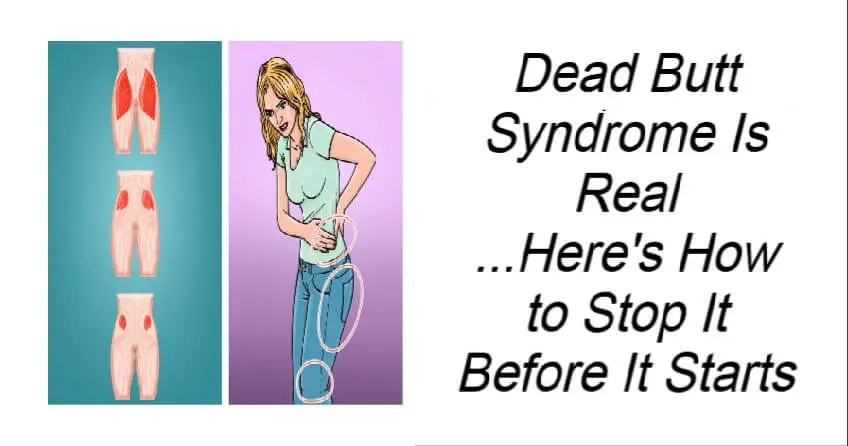
The number one cause is prolonged sitting. When you sit for hours at a desk, in a car, or on the couch, your glutes are lengthened and inactive. Over time, your brain stops prioritizing them for movement.
Your body adapts to what you do most often—and for many people, that’s sitting.
Even people who exercise regularly can develop Dead Butt Syndrome if their workouts rely heavily on:
* Machines that stabilize the body for you
* Quad-dominant movements
* Poor form during squats or lunges
If your glutes never have to “wake up” during movement, they slowly disengage.
### 3. Tight Hip Flexors
Sitting shortens the hip flexors at the front of your hips. Tight hip flexors inhibit glute activation, creating a feedback loop: the tighter the hips get, the less the glutes work.
### 4. One-Sided Habits
Crossing the same leg, always carrying a bag on one side, or favoring one hip when standing can create uneven activation patterns—leaving one glute weaker or less responsive than the other.
—
Dead Butt Syndrome doesn’t usually announce itself clearly. Instead, it shows up indirectly.
### Common signs include:
* Lower back pain that won’t go away
* Hip pain or stiffness
* Tight hamstrings that never seem to loosen
* Knee pain without a clear injury
* Poor balance
* Feeling your quads or lower back do all the work during exercise
* Difficulty “feeling” your glutes during workouts
Ironically, many people with Dead Butt Syndrome believe their glutes are *too tight*—when in reality, they’re underactive and overcompensated for by other muscles.
—
## Why Your Glutes Matter More Than You Think
Your glutes aren’t just for aesthetics. They are central to how your body moves.
* Maintaining upright posture
* Protecting your spine
* Absorbing force when walking or running
* Stabilizing your pelvis and hips
When your glutes don’t fire correctly, your lower back often takes the hit. That’s why so many people with chronic back pain can trace part of the problem back to inactive glutes.
It’s not that your back is weak—it’s working overtime.
—
## How Dead Butt Syndrome Develops Over Time
This condition doesn’t appear overnight. It builds gradually.
1. You sit more than you move
2. Your glutes activate less frequently
3. Other muscles compensate
4. Movement patterns become inefficient
5. Pain or stiffness appears
6. You stretch or treat the painful area—but not the real cause
That’s why treatments that focus only on symptoms often fail. Stretching your hamstrings won’t help if they’re tight because your glutes aren’t supporting them.
—
## How to Tell If Your Glutes Are “Asleep”
You don’t need fancy equipment to get a general sense of glute activation.
Try this simple awareness test:
* Stand up and squeeze your glutes intentionally
* Do you feel a clear contraction?
* Or does your lower back tighten instead?
Another clue: during exercises like bridges or squats, do you feel the work mostly in your thighs or back rather than your butt?
If so, your glutes may be underactive.
—
## Why Stretching Alone Isn’t Enough
One of the biggest mistakes people make is stretching endlessly without activating.
Stretching can help relieve tension, but it doesn’t teach muscles how to function. In fact, overstretching already inactive glutes can make the problem worse.
What inactive muscles need is:
* Activation
* Strength
* Neuromuscular connection
You need to remind your brain that these muscles exist—and are meant to work.
—
## How to Wake Your Glutes Back Up
The good news? Dead Butt Syndrome is highly reversible with consistent effort.
### 1. Reduce Continuous Sitting
You don’t have to stop sitting—but break it up.
* Stand every 30–60 minutes
* Walk for a few minutes
* Do a few bodyweight movements
Movement frequency matters more than intensity.
### 2. Prioritize Glute Activation
Before workouts—or even in the morning—use simple activation exercises like:
* Glute bridges
* Clamshells
* Hip thrust holds
* Standing kickbacks
Focus on slow, controlled movement and mind-muscle connection.
### 3. Strengthen, Don’t Just Activate
Activation is the first step. Strength is what makes the change stick.
Exercises that load the glutes properly include:
* Hip hinges
* Squats with good form
* Step-ups
* Split squats
Quality matters more than weight.
### 4. Stretch the Right Muscles
Instead of stretching everything, focus on:
* Hip flexors
* Quads
* Lower back (gently)
This reduces inhibition on the glutes and allows them to engage more easily.
—
## Why This Isn’t Just a Fitness Issue
Dead Butt Syndrome isn’t limited to gym-goers or office workers. It affects:
* Drivers
* Students
* Remote workers
* Gamers
* Older adults
* Even children who sit for long periods
It’s a lifestyle issue, not a fitness failure.
And because it develops quietly, many people live with it for years—treating symptoms without ever addressing the cause.
—
## The Long-Term Consequences of Ignoring It
If left unaddressed, inactive glutes can contribute to:
* Chronic lower back pain
* Recurrent injuries
* Poor posture
* Reduced mobility as you age
* Decreased athletic performance
Your glutes are foundational muscles. When the foundation weakens, everything above it becomes less stable.
—
## The Encouraging Truth
Dead Butt Syndrome sounds alarming—but it’s also empowering. Once you understand what’s happening, you can do something about it.
You don’t need extreme workouts. You don’t need hours in the gym. You need awareness, consistency, and smarter movement habits.
Your body is adaptable. It responds to what you ask of it.
—
## Final Thoughts
Dead Butt Syndrome is real—not because your muscles are broken, but because modern life has taught your body to forget how to move efficiently.
The fix isn’t punishment or perfection. It’s reconnection.
Stand more. Move often. Activate intentionally. Strengthen patiently.
Your glutes haven’t abandoned you.
They’re just waiting for you to wake them up.
