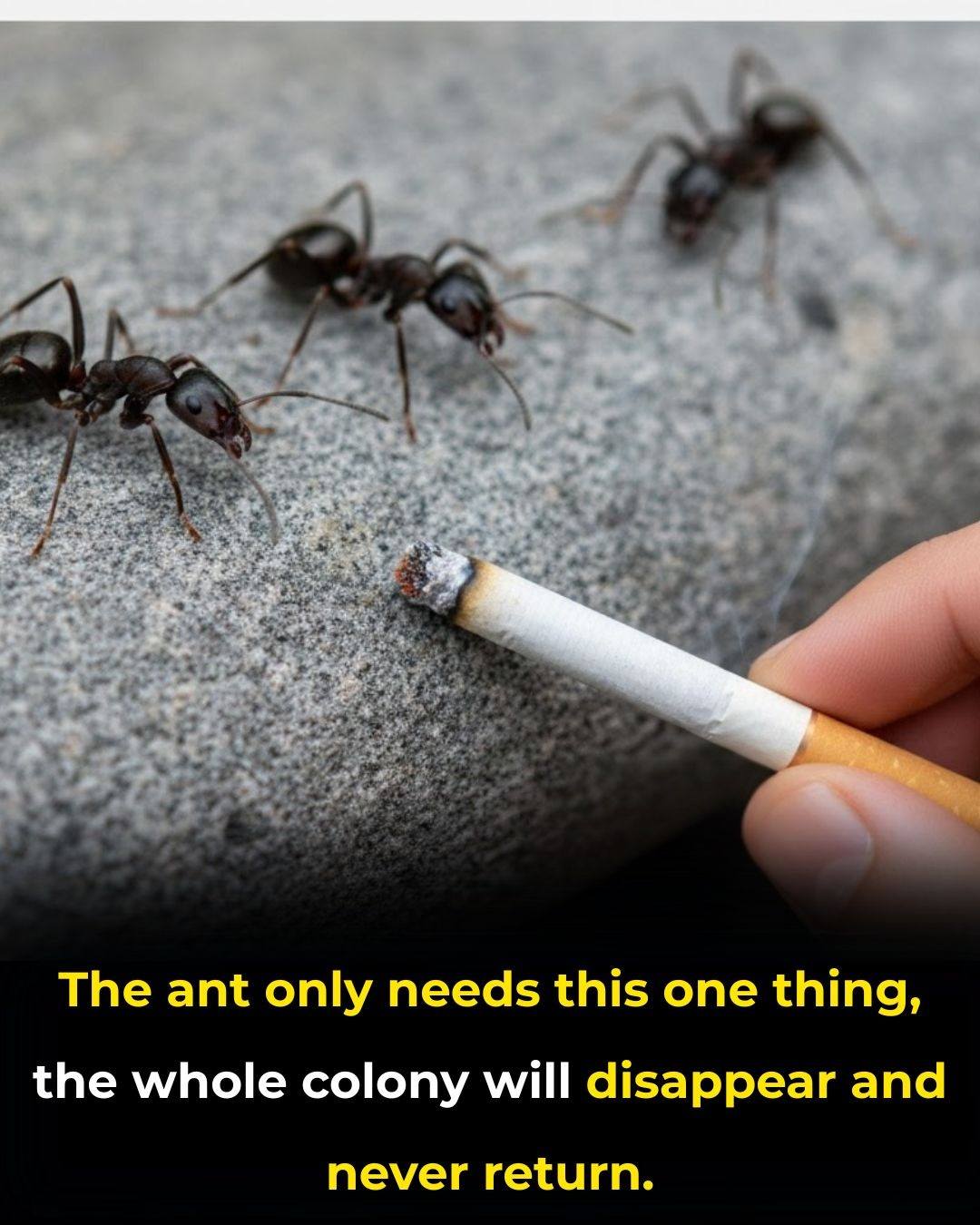
**The Ant Only Needs This One Thing, the Whole Colony Will Disappear and Never Return — Or So the Myth Goes**
Scroll through social media long enough and you’ll inevitably encounter a bold claim: *“The ant only needs this one thing, the whole colony will disappear and never return.”* It’s a headline designed to stop you mid-scroll, promising a simple, almost magical solution to a problem as old as human habitation itself.
They show up in kitchens, bathrooms, gardens, and foundations. They seem to appear overnight, move with eerie coordination, and return even after you think you’ve solved the problem. So when someone suggests there’s *one thing* that can make an entire colony vanish forever, it’s tempting to believe.
But here’s the truth: while there **is** a core principle that determines whether an ant problem disappears or keeps coming back, it’s not a secret ingredient or miracle substance. It’s something far more fundamental—and understanding it changes how you think about ants entirely.
—
## Why Ants Are So Hard to Get Rid Of
To understand why “one thing” matters, you first have to understand ants themselves.
Ants are not individual invaders. They are part of a **superorganism**—a colony that functions like a single body. The ants you see are only a tiny fraction of what exists underground or inside walls.
A typical ant colony includes:
* A queen (or multiple queens)
* Workers
* Soldiers
* Larvae and pupae
That’s why so many ant control efforts fail. People attack the symptom instead of the system.
—
## The Myth of the “Magic Solution”
The idea that “one thing” can eliminate an ant colony usually falls into one of three myths:
1. **Killing visible ants solves the problem**
2. **Strong smells or substances permanently repel ants**
3. **A single treatment wipes out the colony forever**
These approaches may reduce activity temporarily, but ants are incredibly adaptable. If food remains available, if trails are intact, or if the colony’s reproductive system is untouched, ants will return—often stronger than before.
So what’s the real “one thing” ants need?
## The Real Answer: Access to a Reliable Food Source
If you strip away the hype, the one thing an ant colony truly needs to survive near your home is **consistent access to food**.
No food means:
* No worker reinforcement
* No larvae development
* No colony expansion
* Eventual collapse or relocation
Ant colonies are efficient but not invincible. When a food source disappears and remains unavailable, colonies are forced to move or die out.
This is the principle professional pest management is built on—not quick kills, but **resource denial**.
—
## Why Killing Ants Doesn’t Work Long-Term
When you spray or squash ants:
* You remove workers, not the queen
* You leave scent trails intact
* You create stress signals that trigger more foraging
* You often cause the colony to split (a process called budding)
Some ant species respond to danger by creating **multiple new colonies**, which makes the problem worse.
From the colony’s perspective, worker loss is expected. Queens can produce thousands more.
Food loss, however, is catastrophic.
—
## How Ants Find and Exploit Food
Ants don’t wander randomly. They are highly strategic.
1. A scout ant searches for food
2. When it finds something valuable, it leaves a pheromone trail
3. Other ants follow and reinforce the trail
4. The trail strengthens with repeated use
This is why ants seem to “appear out of nowhere” and then suddenly arrive in large numbers.
Remove the food—and erase the trail—and the system collapses.
—
## What Counts as “Food” to Ants?
One of the biggest mistakes homeowners make is underestimating what ants consider a food source.
Ant food includes:
* Crumbs you can see
* Sugar residue you can’t see
* Grease splatter on walls or floors
* Pet food bowls
* Trash residue
* Soap residue in bathrooms
* Dead insects near windows
* Plant secretions outdoors
To ants, a single sticky drop is a buffet.
—
## Why Ants “Disappear” After Certain Treatments
When people claim they used “one thing” and ants vanished forever, what often happened is this:
* The substance eliminated the food source
* The scent trail was disrupted
* The colony determined the location was no longer worth foraging
In other words, the ants didn’t die—they **left**.
From the homeowner’s perspective, it looks like a miracle. From the ants’ perspective, it’s simple math.
No food, no reason to stay.
—
## The Queen Problem
If food access remains cut off long enough, something critical happens: the queen can no longer sustain the colony.
Queens don’t forage. They rely entirely on workers to feed them and the larvae. When workers can’t deliver food, reproduction slows and eventually stops.
This is why professionals focus on **starving the colony**, not attacking it head-on.
—
## Why Ants Sometimes Come Back Months Later
People often say, “They disappeared, but now they’re back.”
This doesn’t mean the method failed. It means conditions changed.
Common reasons ants return:
* Seasonal changes
* New food sources
* Structural shifts in the home
* Changes in moisture levels
* New landscaping or plants
Ants are opportunists. If conditions improve, they investigate again.
The goal isn’t to eliminate ants from the planet—it’s to make your home unappealing to them.
—
## The Psychological Mistake Humans Make
Humans think in terms of enemies and battles. Ants don’t.
They operate on efficiency.
If something costs too much energy for too little reward, they abandon it. That’s the mindset shift that makes ant control effective.
Instead of asking:
“How do I kill them?”
Ask:
“Why are they here, and how do I make it not worth their time?”
—
## The Role of Cleanliness (And Its Limits)
Cleanliness is essential—but not sufficient on its own.
You can have a spotless home and still attract ants because:
* Microscopic residues remain
* Structural gaps allow entry
* Outdoor food sources lead them indoors
* Moisture mimics food availability
Cleanliness is the foundation, not the entire solution.
—
## Why Professional Methods Focus on Behavior
Modern pest control has moved away from brute force. The most effective approaches focus on:
* Interrupting food pathways
* Disrupting foraging behavior
* Preventing trail reinforcement
* Making environments unpredictable
These strategies don’t rely on constant chemical use. They rely on understanding ant biology and psychology.
—
## The Truth Behind “Never Return”
No solution guarantees ants will never return—because ants are part of the ecosystem.
What you *can* achieve is:
* Long-term absence
* Fewer infestations
* Faster disappearance when ants do appear
* Control without constant intervention
Homes that manage food access properly often go years without seeing ants, even in high-ant regions.
—
## Why This Matters Beyond Ants
The “one thing ants need” principle applies to many pests.
Rodents need shelter and food.
Flies need moisture and organic matter.
Cockroaches need warmth and residue.
Remove the resource, and the pest disappears—not because it was destroyed, but because it moved on.
—
## Final Thoughts
The headline isn’t entirely wrong—but it’s misleading.
The ant doesn’t need a miracle substance.
It doesn’t need a powerful chemical.
It doesn’t need fear or force.
It needs **food**.
Continue reading…
